


Sancti Petri
Sancti Petri
Chasing Hercules to the Edge of Spain

Published August 10, 2026
The boat doesn’t care what time your alarm went off. It leaves when the Atlantic says it can leave, and not one minute before. That’s the first thing you learn about Sancti Petri, the small fortress island off the Cádiz coast, and it’s the thing that makes it worth chasing in the first place.
Tabatha and I found this place almost by accident, a name on a map that turned out to be sitting on top of one of the oldest stories in the Mediterranean. Most people driving the Cádiz coast blow right past it, chasing beach bars in Chiclana, tapas in San Fernando, never once looking out at the little fortress sitting alone on its own rock offshore. Their loss. That rock marked the edge of the known world, and we were going to go stand on it.
Arriving at the Sancti Petri Marina
A handful of boats, a ticket window, a couple of tapas joints not yet awake for the day. Nothing about the Puerto Deportivo de Sancti Petri screams “here lies the tomb of a demigod.” That’s exactly how you know you’re in the right kind of place. The real ones never advertise.
The boat itself holds about a hundred people, rows of seats below, and an open bow up front where you can stand and watch the castle grow larger against the horizon. That bow spot is the one everyone wants, which means it’s a small, friendly war to get up there. If you want the shot, phone or Insta360 or otherwise, you’re fighting the crowd for real estate on that bow rail. Do it anyway. It’s worth every elbow you throw.
The crossing itself is fifteen minutes, nothing, a cigarette and a decent song. But which fifteen minutes you get is up to the tide, not you. We had a slot booked. The tide had other ideas. We waited, watched the water pull back off the flats like it was showing us something it didn’t quite want to reveal yet, and went when it was ready, not when we were.
Here’s the part that stings a little: the boat actually has a glass bottom, a real window built into the hull so you’re supposed to watch the seafloor slide by underneath you. In practice, algae has grown so thick over the glass that you can’t see a thing down there. Somewhere, a diver with a scraper and twenty minutes could fix this and hand every rider on that boat a small miracle. Nobody’s done it yet. So don’t expect the underwater view. Expect a green smear and the disappointment of a missed opportunity.
Fifteen euros gets you the boat and the castle. There’s a night version too, sunset timed, live music some evenings, for a few euros more, if you want the theatrical version instead of the practical one.
Tip: Book ahead through the island’s own site, not a third-party reseller, and expect the exact departure time to shift based on tide conditions. Fight for the bow. Don’t count on the glass bottom.
Where They Buried a God, Maybe
Here’s the pitch the ancient world gave itself, and it’s a hell of a pitch: somewhere on this rock stood the Temple of Melqart-Hercules, and inside it, the supposed tomb of Hercules himself, planted here after he killed a local king named Geryon and walked off with his cattle like it was Tuesday. Whether a word of it is true doesn’t matter. Phoenician sailors and Greek traders were already treating this exact patch of Atlantic as sacred before Rome was a rumor, and that kind of belief leaves a residue you can still feel standing on the stones.
This wasn’t just a temple on a random beach, either. This was the edge. Past the Pillars of Hercules, past everything the ancient Mediterranean world considered known and mapped and safe. Stand on that islet and look out at open Atlantic, and you’re looking at what Greek sailors genuinely believed was the boundary of the earth itself. Some ancient sources placed the entrance to Hades out past these same waters. People who crossed to get here weren’t just sightseeing. They were sailing to the last dot on the map, and some of them believed the underworld started somewhere past the horizon they were staring at.
It gets better. Later writers weren’t content with Hercules alone, they had to drag Hamilcar Barca, Julius Caesar, and Hannibal through here too, each one supposedly stopping to pay respects to a dead demigod on his way to conquer something bigger. Real history, half-myth, ancient marketing, take your pick. Standing on that islet with the water pulling at the causeway behind you, edge-of-the-world does not feel like an exaggeration. It feels like the actual, literal claim ancient sailors were making, and for a while, nobody could prove them wrong.
The temple wasn’t just a shrine, either. One of the site’s own placards lays this out better than I can paraphrase it: Phoenician temples doubled as schools, archives, and markets, karim, in the old word for it, and the one here likely controlled trade in salted fish and garum, the fermented fish sauce Gadir shipped across the ancient Mediterranean by the barrel. The historian Timaeus described Phoenician fishermen sailing past the Pillars of Herakles, hauling in tuna almost too large to believe, salting it down, and shipping it to Carthage in such volume that the Carthaginians kept the best of it for themselves. This wasn’t a temple for quiet prayer. It was a temple that ran a fishing empire on the side.
And somebody already tried the gold-hunter routine on this exact spot, eight hundred years before we showed up. Arab chronicles describe a monument here, possibly a version of Melqart’s tomb-tower, that stood as a landmark for sailors for centuries. In 1145, a rebel named Abu-l-Hasan, convinced the thing was solid gold, tore it down to get at the treasure. He got twelve thousand gold dinars off the gilding. Underneath the gold leaf: brass. The whole monument was scrapped for scrap metal, and the guy who did it still walked away thinking he’d won. If you’re chasing treasure on this rock, you’re not the first, and you won’t be the last person to leave with less than you hoped.
The Actual Sancti Petri Mission
Here’s what we actually came looking for: proof. Proof that Geryon was more than a bedtime story for ancient sailors, and proof that this island is where they buried the god who supposedly killed him.
Turns out we’re in good company chasing that, because nobody has settled it either. For decades, the assumption was that the Temple of Melqart-Hercules sat right here on the islet’s south end. Then in 2021, a PhD student at the University of Seville named Ricardo Belizón was staring at LiDAR terrain data, the kind of laser-mapped elevation data Spain uses to survey its coastline, and spotted something that shouldn’t have been there: a rectangular structure nearly a thousand feet long, sitting submerged in the shallow channel right next to the castle, invisible except at low tide. His team, backed by Andalusia’s own heritage institute, went public with the theory that they’d found the actual temple.
Except a rival camp of researchers, tied to the Universities of Cádiz and Córdoba, looked at the same historical record and landed somewhere completely different, a hill on the mainland called Cerro de los Mártires, three hundred meters inland and nowhere near the water. Two teams, two locations, one ancient temple that supposedly hosted Julius Caesar and Hannibal, and to this day, nobody has put a shovel in the ground at either site to settle it.
Here’s the other question we couldn’t let go of, and I want to lay it out straight rather than tell you what to think. Was Geryon one of the Nephilim? The Nephilim come from Genesis, offspring described in the Hebrew Bible, giants walking the earth before the flood. Geryon comes from Greek myth, a three-bodied giant living at the edge of the world, first written down by Hesiod, killed by Herakles for his cattle in the tenth labor. Different books, different religions, different continents of origin, centuries apart in their earliest surviving texts.
Here’s the case for a connection, and it’s not nothing: giant-figures show up at the far edges of the map in an unusual number of ancient traditions, guarding treasure, guarding cattle, guarding the boundary between the known world and whatever comes after it. Some people who study comparative mythology point to that pattern and ask whether separate cultures were describing the same inherited memory in different languages. Here’s the case against it: there is no ancient text, no inscription, no archaeological find that draws a direct line between the two. Mainstream historians treat them as unrelated stories that happen to share a size. No scholar has published a serious case connecting them specifically.
We stood on that rock, at the edge of what the ancient world considered the edge of everything, and asked the question anyway. You’ve got the same evidence we did now. Decide for yourself.
What's Actually Lying Around the Fort
This is the part most people miss entirely, because they come for the view and leave without looking down. Walk the halls and you’ll find a row of old heraldic shields leaned against a whitewashed wall, Maltese crosses, fleur-de-lis, lions worked into the metal, chained in place like someone learned the hard way that souvenirs walk off. A few steps further, tucked into a niche cut straight into the stone, sits a two-handled amphora, decorated with a band of diamond etching, standing exactly the way you’d imagine finding it if you’d been the one to dig it out. Nobody’s roped most of it off behind glass. It’s just there, sitting in the open where soldiers and priests and whoever else left it behind.
There’s a Napoleonic-era soldier’s uniform on display too, deep red wool with a soldier’s stiff-brimmed cap, standing guard next to a full iron cannon on its original wooden carriage, right beside the wall panels explaining exactly which century that gun belonged to. Somebody could write an entire Indiana Jones script out of what’s scattered across this one small islet, and most visitors walk right past it hunting for a good photo of the horizon. Slow down. Look at the ground, not just the view. The story’s under your feet as much as it’s out past the water.
And here’s the twist that makes the algae-covered glass bottom sting even more: this channel isn’t just hiding a maybe-temple. One of the exhibit panels lays out a genuine, confirmed underwater graveyard just offshore, seven iron cannons still sitting on the reef, another thirty buried in the sand off Camposoto beach along with an anchor, ship timbers, and bronze fittings, all pointing to a large French warship, quite possibly the Fougueux, lost off this exact coast after the Battle of Trafalgar. That’s a real, identified wreck, sitting a short swim from where tourists ride past a blacked-out glass floor and see nothing. Somebody is sitting on two mysteries in the same stretch of water and only advertising the one with a mythological hook.
The island also runs a short history exhibit, videos walking you through the site’s past. When we went, ours played in Spanish. They do have an English version, though I can’t tell you the exact showtimes, so ask when you book, or when you land, whichever comes first.
What You Need to Know Before Visiting Sancti Petri
Book everything straight through elcastillodesanctipetri.com, the outfit that actually runs the island, not a reseller. The day catamaran runs from 15 euros a person and gets you the boat, the crossing, and the guided walk through the ruins. Want the sunset version instead, live music some nights, that colored-sky moment, expect closer to 23 euros.
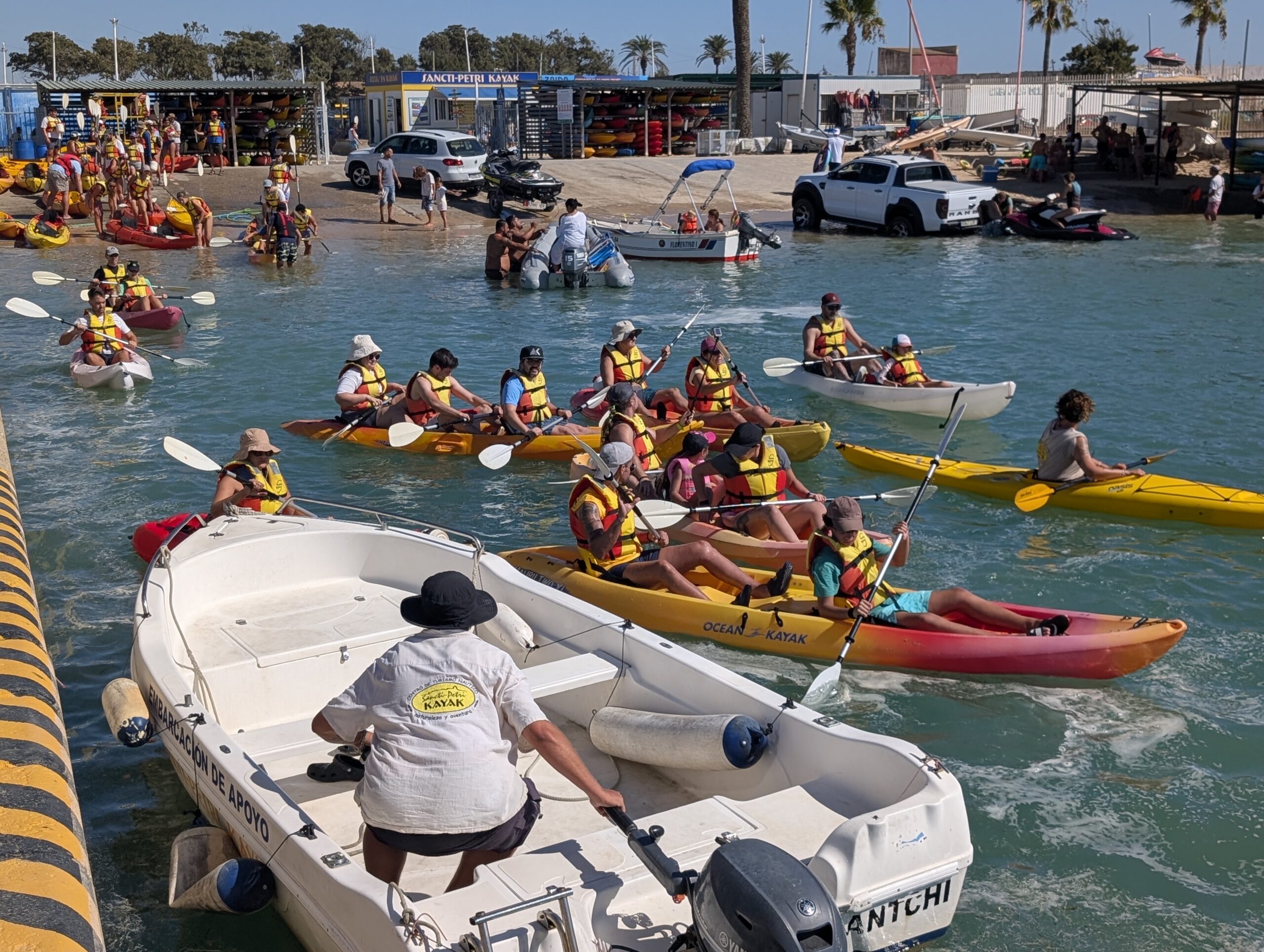
If you’d rather earn the crossing than ride it, they also run a three-hour guided kayak route out to the castle, solo or tandem boats, running around 17 euros depending on the season, so check their calendar before you commit to paddling yourself out to a demigod’s tomb.
The catamaran tour runs two hours total: they drop you on the islet, and you’ve got two hours on the ground before that same boat comes back for you, whether you’re ready or not. Spend some of that time on the artifacts scattered around the grounds, not just the view. Catch the history video if the English showing lines up with your visit. And don’t skip the covered seating area near the dock, where they sell beer for around four euros a glass alongside simple tapas.
Sitting there with a cold beer, watching the water that ancient sailors genuinely feared to cross, looking for the tomb of a demigod nobody’s found, felt about as unreal as travel gets. That contrast, ice-cold beer where people once thought the world ended, is worth the trip on its own.
Final Thoughts
We didn’t find the temple. Neither has anyone else, not with a shovel, anyway. Somewhere between that castle and a hill three hundred meters inland, there’s a two-thousand-year-old sanctuary that hosted Julius Caesar and Hannibal, and it’s still just a shape in laser data, argued over by two universities who can’t agree which patch of ground to dig. That’s not a disappointing ending. That’s the actual state of the case, and it’s a far better story than a fake yes would have been.
Some places you visit for the view. Sancti Petri is one you visit because people who came before you were already convinced they’d found the edge of the world, the last stop before Hades itself, and three thousand years later, professionals with better equipment than us still can’t prove them wrong.
The Actual Sancti Petri Mission
i AM bODY
If you would like to read more about my travels, check out TravelingAmerican.org